BlogsClimate changeINTO Projects
Celebrating two World Heritage sites through ‘Salt and Stone’
September 21, 2026

A new blog by INTO’s ‘Salt and Stone’ Programme Manager, Charlotte Thomas
As organisations, governments, and climate leaders gathered this week for London Climate Action Week, discussions focussed on how communities can adapt to a changing climate. Topics such as climate finance, resilience, and adaptation are now firmly on the global agenda, something which is all the more apparent now as the UK heats up boasting the hottest June on record at 38°. Yet one question is often overlooked:
What happens to our cultural heritage as the climate changes?
Historic buildings, cultural landscapes, and heritage sites are increasingly exposed to rising temperatures, changing rainfall patterns, stronger storms, coastal erosion, and sea level rise. These places are more than physical assets. They are repositories of knowledge, identity, memory, and community life.
For island nations, where climate impacts are often felt first and most intensely, this challenge is already a reality.
On 25 June, INTO Secretary-General Catherine Leonard joined heritage and climate leaders at the symposium Resourcing Culture-Based Climate Action at Scale during London Climate Action Week. The event explored how culture and heritage can contribute to climate action and community resilience. It is an important conversation because around the world, heritage organisations are increasingly asking not only how climate change will affect historic places, but also how heritage can help communities respond to it.
One example can be found thousands of miles from London, on the islands of Zanzibar and the Comoros.
Island communities have always adapted to challenging environments. Coastal exposure, seasonal storms, humidity, and fluctuating weather patterns have shaped how people build, maintain, and inhabit historic places.
Today, climate change is intensifying many of these pressures.
Across island nations, rising temperatures, more intense rainfall, coastal erosion, salt-laden winds, and changing weather patterns are placing growing pressure on both communities and the historic buildings they care for. Unlike many mainland locations, islands often have fewer resources available for large-scale adaptation and recovery efforts, making resilience even more important.
For heritage organisations, island sites can act as an early warning system. They offer valuable insights into how climate change is affecting historic places and what conservation approaches may be needed in the future.
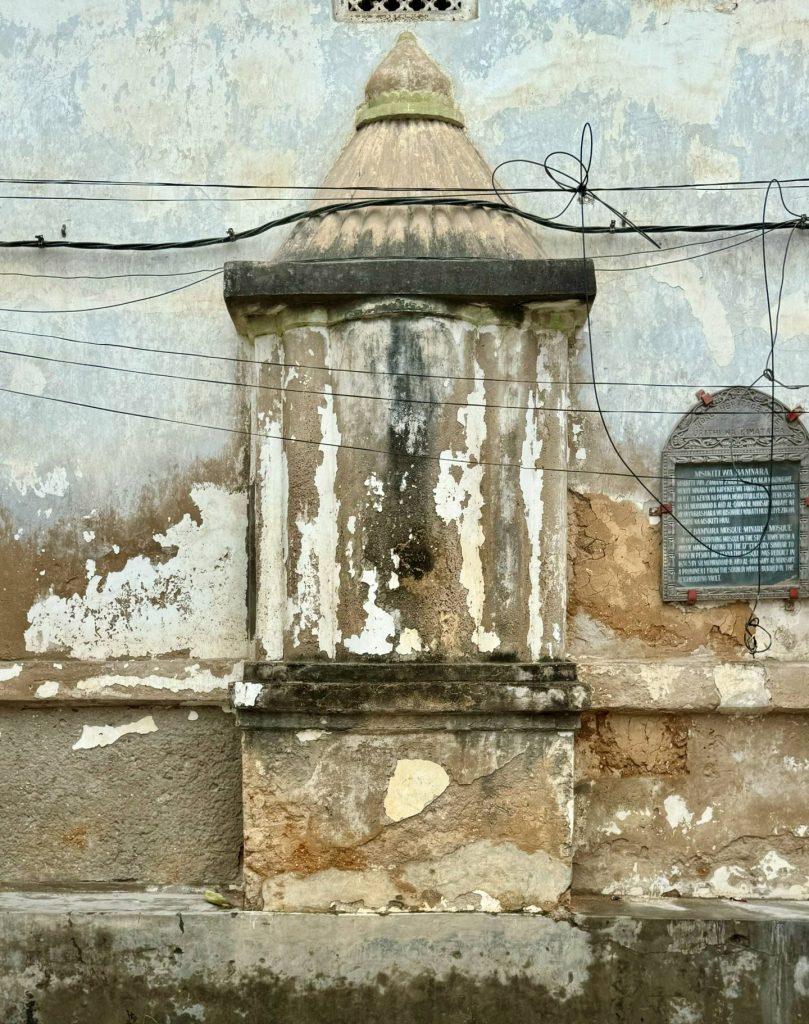
Exterior of the Ba’Mnara mosque in Stone Town, Zanzibar showing the effects of salt erosion
Climate change can sometimes feel abstract when discussed through statistics and policy commitments. Historic buildings help make those impacts visible.
A rise in humidity can encourage mould growth and accelerate timber decay. More intense rainfall can increase water penetration, erode traditional mortars, and damage historic finishes. Salt carried inland by sea spray can crystallise within stone and plaster, causing surfaces to crack and detach. Repeated cycles of wetting and drying place additional stress on materials that may already be centuries old.
Many historic buildings were designed to respond to local environmental conditions. Traditional builders understood prevailing winds, rainfall patterns, and the importance of breathable materials. However, climate change is altering those conditions, often at a pace faster than historic buildings can naturally adapt.
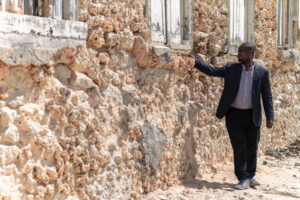
Traditional building materials, such as the coral stone seen here in Stone Town, face accelerated decay due to climate change
As weather patterns become more extreme and less predictable, maintenance cycles become shorter, deterioration can accelerate, and the costs of conservation increase.
The challenge facing heritage organisations is therefore not only how to conserve historic fabric today, but how to ensure that historic places remain resilient in the climate of tomorrow.
Through INTO’s ‘Salt and Stone’ project, we are seeing first-hand how climate change is affecting historic buildings in Zanzibar and the Comoros. At Ba’mnara Mosque and the Swaniani Princely House, increasing humidity, heavier rainfall, salt-laden air, and water ingress are placing growing pressure on traditional building materials and historic fabric.
These sites reflect a wider challenge facing island heritage. Climate change is threatening not only historic structures, but also the knowledge and skills needed to care for them.
Building climate resilience through heritage
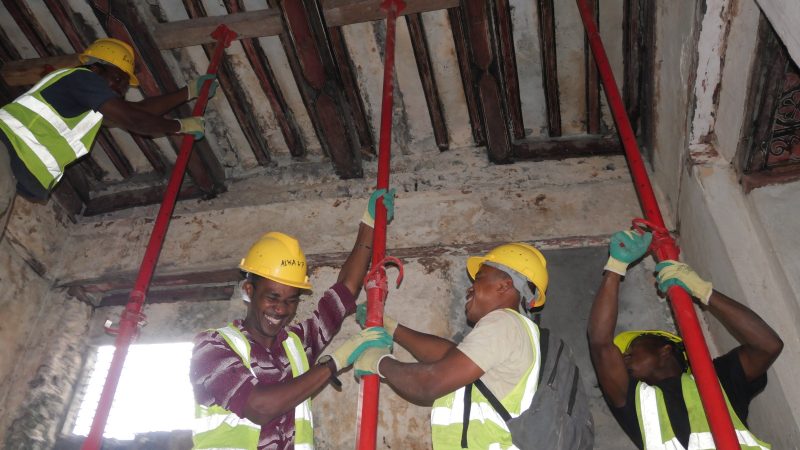
Responding to these challenges requires more than conservation works alone. Through practical conservation, training, and knowledge exchange, ‘Salt and Stone’ is helping local partners strengthen their capacity to care for historic buildings in a changing climate.
By combining traditional building knowledge with contemporary conservation practice, the project seeks to develop solutions that are both culturally appropriate and environmentally resilient.
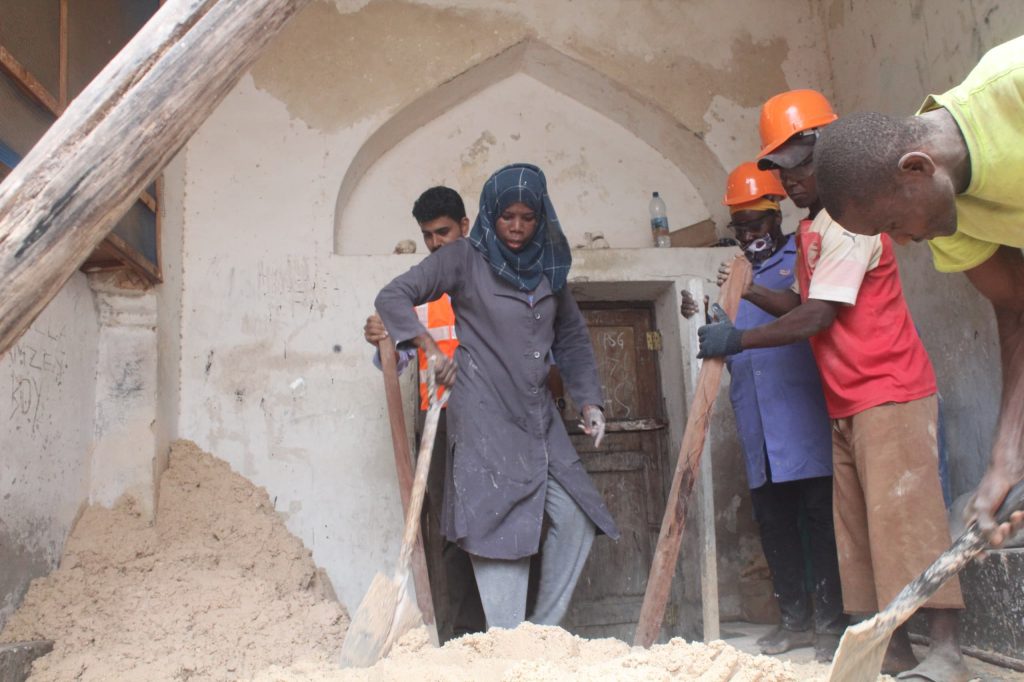
Stone Town traditional masonry and plasterwork workshop
While the challenges facing Zanzibar and the Comoros are shaped by their island environments, the questions they raise are relevant far beyond the Western Indian Ocean.
Across the INTO network, heritage organisations are grappling with the impacts of climate change. Coastal erosion, stronger storms, flooding, drought, wildfire, and changing weather patterns are affecting historic places in every region of the world.
The experiences of island nations remind us that climate change is not a distant threat. It is already reshaping the way we care for heritage.
As conversations continue during London Climate Action Week about how communities can adapt to a changing climate, heritage has an important role to play. Historic places can help us understand environmental change, preserve traditional knowledge, strengthen community identity, and provide practical lessons in resilience.
Projects such as ‘Salt and Stone’ demonstrate what culture-based climate action looks like in practice. By combining heritage conservation, skills development, and climate adaptation, they show how protecting cultural heritage can also help strengthen communities facing environmental change.
Climate adaptation is not only about protecting infrastructure or ecosystems. It is also about protecting the places, stories, and traditions that connect people to their past and help them navigate their future.
As climate change reaches more shorelines, more communities, and more historic places, the lessons emerging from Zanzibar and the Comoros may prove increasingly valuable for us all.
September 21, 2026