
Headquarters House: histories of architecture and enslavement in Jamaica
A new blog by Dr Zakiya McKenzie, Programme Manager, RISE and Senior Research Associate, Plants, Enslavement and Public History project.
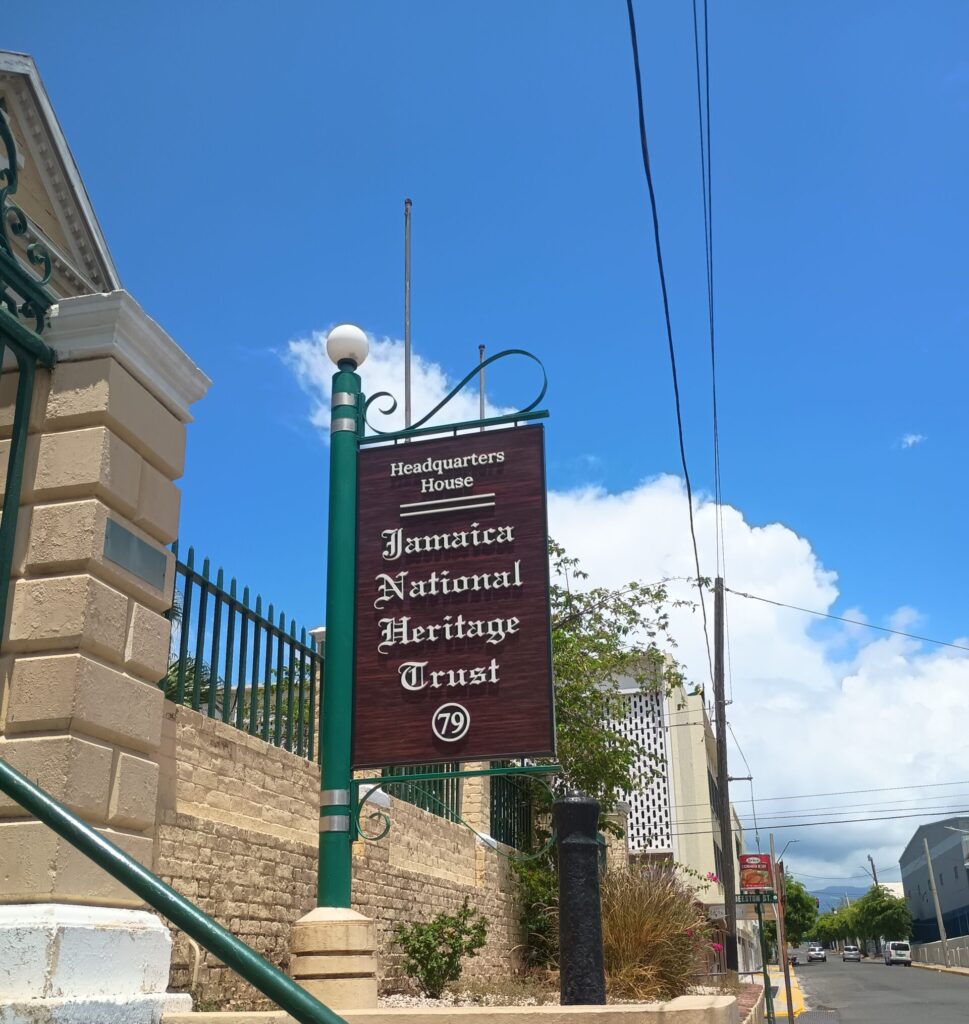
Last summer I visited Jamaica for a research trip to better understand connections between enslavement and national heritage sites across the island. At 79 Duke Street in Kingston stands Headquarters House, the administrative home of the Jamaica National Heritage Trust (JNHT). Here I was hosted by Jamaica’s RISE representative, Lorna Bailey (Director of Public Education, Public Relations and Communications, JNHT) and Georgia Rookwood, JNHT’s Senior Research Officer.
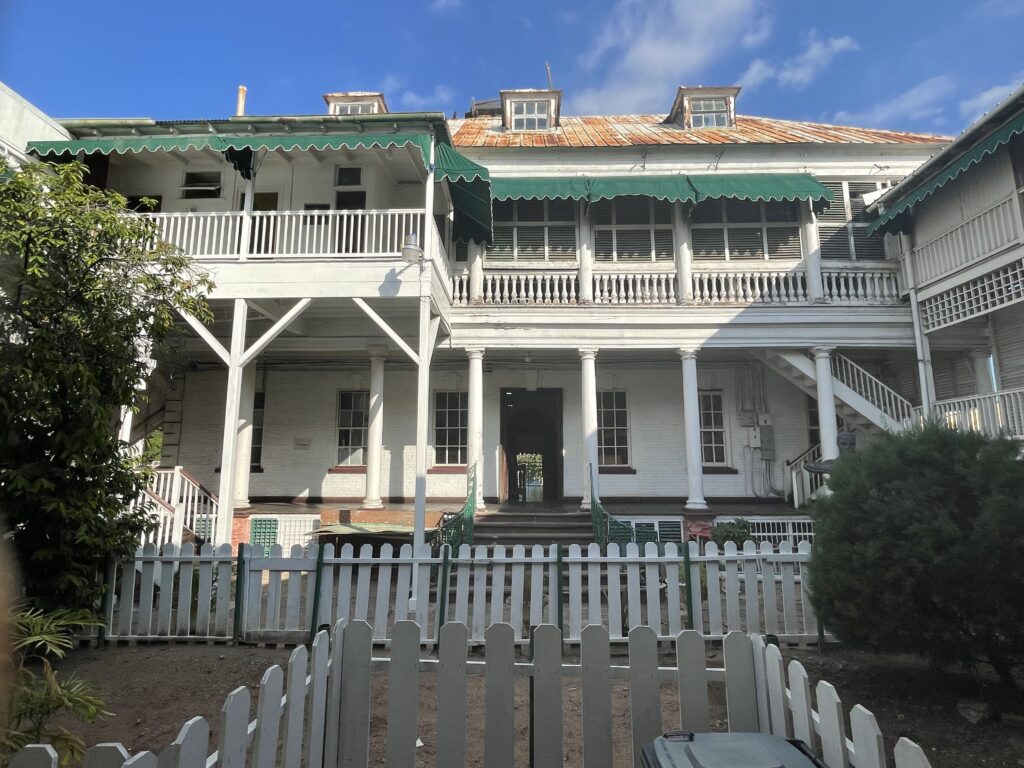
Headquarters House exterior
A tour of Headquarters House
I was also given a comprehensive tour of Headquarters House by Curator of Artefacts, Ann-Marie Howard-Brown, and Tour Guide, Tiana Fung. From basement cellar to inner courtyard, to the view of the old harbour from the attic, my guides narrated a rich history of Jamaica through the story of the building, craftsmanship and use of space at Headquarters House.
Once known as Hibbert House, the building represents a material link between the architectural and economic structures of Jamaica’s colonial past.
Constructed in 1755 by Thomas Hibbert, it is one of the earliest complete examples of Georgian architecture in the Caribbean region. Hibbert was born into a wealthy Lancashire family of cotton merchants who were no strangers to the Americas since their textiles widely circulated Atlantic trade ports.
Still, Thomas Hibbert was the first of his family to settle in Jamaica, arriving in 1734. He quickly rose to the top of Kingston’s commercial and social elite, establishing the Hibbert name as one of the foremost West Indian merchant families.
With business partner Nathaniel Sprigg, Thomas Hibbert supplied Jamaican plantations with tens of thousands of enslaved people by working as middlemen known as ‘slave factors’. At Kingston port, Hibbert and Sprigg boarded just-landed slave ships and purchased the captured African passengers before their feet even touched the Jamaican shore. Slave factors then resold the enslaved people to plantation owners across the island.
With the success of business, Thomas Hibbert decided to build a Kingston townhouse overlooking the downtown commercial district and harbour. With its tray-vaulted ceiling and mahogany floors and stairs throughout the entire house, Hibbert’s residence was a modern beauty to Jamaica’s enslavers.
In the attic, remnants of an internal rainwater harvesting system as well as shelving and partitions point to it being a well-used and functional space. A widow’s walk and crow’s nest on this uppermost floor allowed Hibbert to survey slave ships coming in and out of the port.
In 1792, the Jamaican Assembly ordered that the sale of enslaved people be moved from ship to shore. The Hibbert family took this opportunity and conducted the auction of those who survived the arduous and abusive journey from Africa, at Hibbert House.
The basement of the house was altered to include a dungeon where the captives were held. Sales took place in the inner courtyard of the residence. Large numbers of enslaved Africans spent their first days and nights in Jamaica at this building on the corner of Duke and Beeston Streets in Kingston.
It is a sweet repurposing to me, that the building is now home to JNHT – the organisation tasked with preserving and interpreting Jamaica’s cultural history.
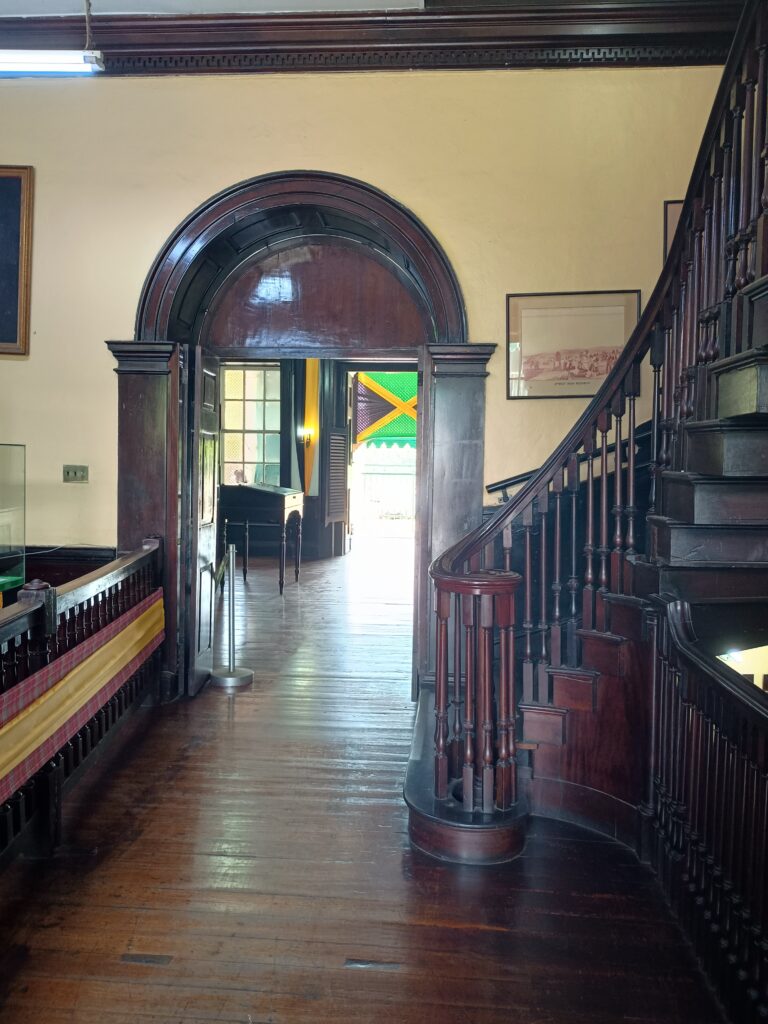
Interior of Headquarters House, showing mahogany floors and architectural details
Charity Harry and Thomas Hibbert
Thomas Hibbert did not legally marry, but he fathered three daughters with the ‘free, mulatto housekeeper’ who lived in a property beside the main house. Her name was Charity Harry and she was the subject of a private act of the Jamaican Assembly in 1775 which granted her the same rights as white English colonials, except voting and holding office.
It was not uncommon for the mixed-race children of Englishmen to be the beneficiary of such ‘private’ laws in Jamaica at the time; the historical record shows that the racial and social strata was often muddled or disregarded in this way to accommodate the technically illegal, and sometimes, conjugal relationships of the enslaver-merchant class and women of African descent. There is no definitive record yet found that speaks to whether Harry consented in her relationship with Hibbert, but we do know that Charity Harry inherited land and slaves from him upon his death.
Even as a non-white, woman and having had no sons (heirs) for Thomas Hibbert, Charity Harry maintained her wealth and became a part of Jamaica’s enslaving elite.
Jane Harry Thresher and anti-slavery in England
Harry and Hibbert had three daughters. The eldest, Jane Harry was born in 1755 – the same year Hibbert House was completed. Her youngest sister did not survive early childhood. Then in 1771, she and her surviving sister Margaret were sent to live in England to be educated under the care of Nathaniel Sprigg. When Margaret died at boarding school, Jane Harry sought comfort in friend, Mary Morris Knowles.
Mary was from a well-respected Quaker family whose influence on Jane led to she too embracing Quakerism. Jane may have been turned away from the Sprigg household upon joining the abolitionist sect and, soon after she left the Sprigg’s, she became known as a vocal anti-slavery activist.
With first-hand knowledge of the horrors of slavery from her childhood at Hibbert House, Jane vowed to return to Jamaica to free her mother’s slaves. Though she never crossed the sea back to the place of her birth, and did not convince her mother to free her enslaved, Jane Harry Thresher spent the rest of her life advocating for abolition. She died in 1784.
Though no named artworks of hers remain, Jane Harry Thresher is also remembered as a celebrated painter who won an award from the Society for the Encouragement of Arts and Commerce in 1775.
Headquarters House today
Meanwhile, Thomas Hibbert became involved in politics and was named Speaker of the Jamaica House of Assembly in 1756. Hibbert’s influence extended beyond Jamaica; in 1772–1773, he contributed £50 to Dr John Morgan’s fundraising tour of the West Indies in support of the University of Pennsylvania.
Headquarters House later served as the official seat of the Jamaican Legislature from 1872 to 1960, before the government relocated to Gordon House a few doors away, where parliament still meets today.
Headquarters House retains much of its original interior and it is also home to the piano used in the composition of the Jamaican national anthem. An image of the exterior of the building appeared on the five-dollar Jamaican banknote following restoration in 1982 until the note was discontinued.
Today, as the administrative home of the Jamaica National Heritage Trust, Headquarters House stands as survivor and witness – a monument that embodies the resilience, resourcefulness and pride of the country’s heritage workers who are countering the enduring memory of a violent past.
Selected sources
Crawford, Edward, ‘Individuals of Part-African or African Descent Named in Acts of the Jamaican Assembly 1760-1810’, Rootsweb Online, 15 August 2022
Donington, Katie, ‘The Bonds of Family: Slavery, Commerce and Culture in the British Atlantic World’, in The Bonds of Family (Manchester University Press, 2019)
Jones, Cecily, and Amar Nahab, ‘Free at Last? Reflections on Freedom and the Abolition of the British Transatlantic Slave Trade’ (Cambridge Scholars Publishing, 2011)
Nelson, Louis P. ‘Architecture and Empire in Jamaica’ (Yale University Press, 2016)
Patricia E. Green Architects – ‘Jamaica: Hibbert House /Headquarters House’, n.d.